 Brokers' Picks Brokers' Picks
by Dorothy Hoffert
November 17, 2004
www.resourceworldmag.com
The increasing
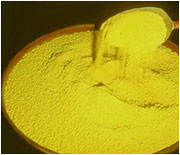
price of uranium, also referred to as "yellowcake,"
has recently caused a great deal of market activity for the shares
of companies focused on uranium exploration - whether they are
grassroots or advanced projects. The price of uranium has increased
from US $12.75 per pound at the end of October 2003 to its current
levels of $20.00 per pound with prices expected to continue to
rise.
World consumption of uranium has been exceeding production for
a number of years. The shortfall has been made up through secondary
sources such as excess inventories, the dismantling and recycling
of nuclear weapons and used reactor fuel that has been reprocessed.
Concerns over shortages of oil and gas with resulting high prices
in these fossil fuels, along with environmental issues regarding
greenhouse gas emissions has fueled a new interest in nuclear
energy as the source of power to meet current and future global
demand for electricity.
Nuclear energy offers a clean and efficient alternative to energy
produced from coal, oil or natural gas. Electricity is produced
at lower costs and a nuclear generating plant does not produce
carbon dioxide emissions. New supplies of uranium will come at
a higher cost which, in turn, will continue to put upward pressure
on the price of uranium.
The Athabasca
Basin of northern Saskatchewan, Canada is the largest and richest
uranium producing region in the world and accounts for more than
33% of annual world production.
Cameco Corporation [CCO-TSX; CCJ-NY] is the world's largest,
low-cost uranium producer and supplies 20% of the world's consumption.
The company operates and owns a controlling interest in uranium
mines and mills at McArthur River, Key Lake and Rabbit Lake,
all located in the Athabasca Basin. The McArthur River Mine is
the world's largest, highgrade uranium deposit with proven and
probable reserves of 437 million pounds of U3O8. The average
ore grade is 25% U3O8 and is valued at US $10,000/ton, a gold
equivalent of 25 oz/ton. Given the above numbers, it is no wonder
why there is enormous interest in exploring for uranium in this
region of Canada.
The die-hard of the junior uranium explorers is JNR Resources
Inc. [JNN-TSXV]. The company first began its land acquisition
program in the Athabasca Basin in 1997. JNR joint ventured these
projects with Kennecott (between 1998 and 2002) which
made over $6 million in expenditures developing promising targets.
Unconformity-type uranium mineralization was discovered on the
Moore Lake property in 2000 and significant uranium mineralization
was intersected in the third hole of a 10-hole program, returning
0.442% U3O8 over 9.2 metres. In the fall of 2003, JNR formed
a joint venture on the Moore Lake property with International
Uranium Corp. [IUC-TSX]. The 2004 diamond drilling program
focused on following up the uranium mineralization in the Maverick
Zone. Assays released in August included 5.0 metres of 3.5% U3O8
and 6.2 metres of 5.14% U3O8 and results released in September
assayed 4.03% U3O8 over 10 metres which included a 1.4-metre
intercept 19.96% U3O8.
Northern Continental Resources Inc. [NCR-TSXV] also recognized
the growing need for economic sources energy and acquired a large
land package in the heart of the Athabasca Basin's most productive
zone. The Russell Project encompasses 39,378 hectares (93,305
acres) and is situated on strike and midway between the former
producing Key Lake deposit and the MacArthur River deposit and
west of the Moore Lake project. The property has year-round access.
There is a power line, and the all-weather road located along
the northwest boundary of the property is used to transport uranium
ore from the McArthur River Mine to Key Lake for processing.
Historic exploration conducted by SMDC (the predecessor
to Cameco) on the Russell Project resulted in the discovery of
the Grayling Zone and NCR's exploration has focused on this zone.
Diamond drill holes intersected sub-economic uranium mineralization
grading 3.45% U3O8 over 0.3 metres and 0.4% U3O8 over 3.75 metres
over a strike length of 800 metres. The holes encountered the
basal Athabasca Group unconformity at 320-350 metres below surface
within a zone of strong structural deformation and hydrothermal
alteration. Four other areas outside of the Grayling Zone have
been identified for further exploration. This year's initial
exploration program will include 60 km of line cutting and electromagnetic
surveys to confirm drill set-up locations and 3,600 metres of
diamond drilling in 10 holes.
Trading volumes in "uranium shares" has slowed down
in recent weeks. However, as exploration programs are ongoing,
more news from these companies will be forthcoming and the market
slow-down offers good opportunities for aggressive investors
to add shares of these companies to their portfolios as the long-term
uranium market outlook remains positive.
Other juniors active in the area are CanAlaska Ventures Ltd.
[CVV-TSXV], Consolidated Abaddon Resources Inc. [ABN-TSXV],
Formation Capital Corp. [FCO-TSX], Southern Cross Resources
Inc. [SXR-TSX] and United Carina Resources Corp. [UCA-TSXV]
to mention a few.
November 2004 www.resourceworldmag.com
Dorothy Hoffert
 Dorothy Hoffert has been an Investment
Advisor for 20 years with a focus on the Mining Sector. Dorothy Hoffert has been an Investment
Advisor for 20 years with a focus on the Mining Sector.
She can be reached at Wolverton Securities at 604-662-5271.
Dorothy Hoffert, her clients and/or Wolverton directors, employees
or clients may own shares in any of the companies discussed.
________________
321gold Inc

|